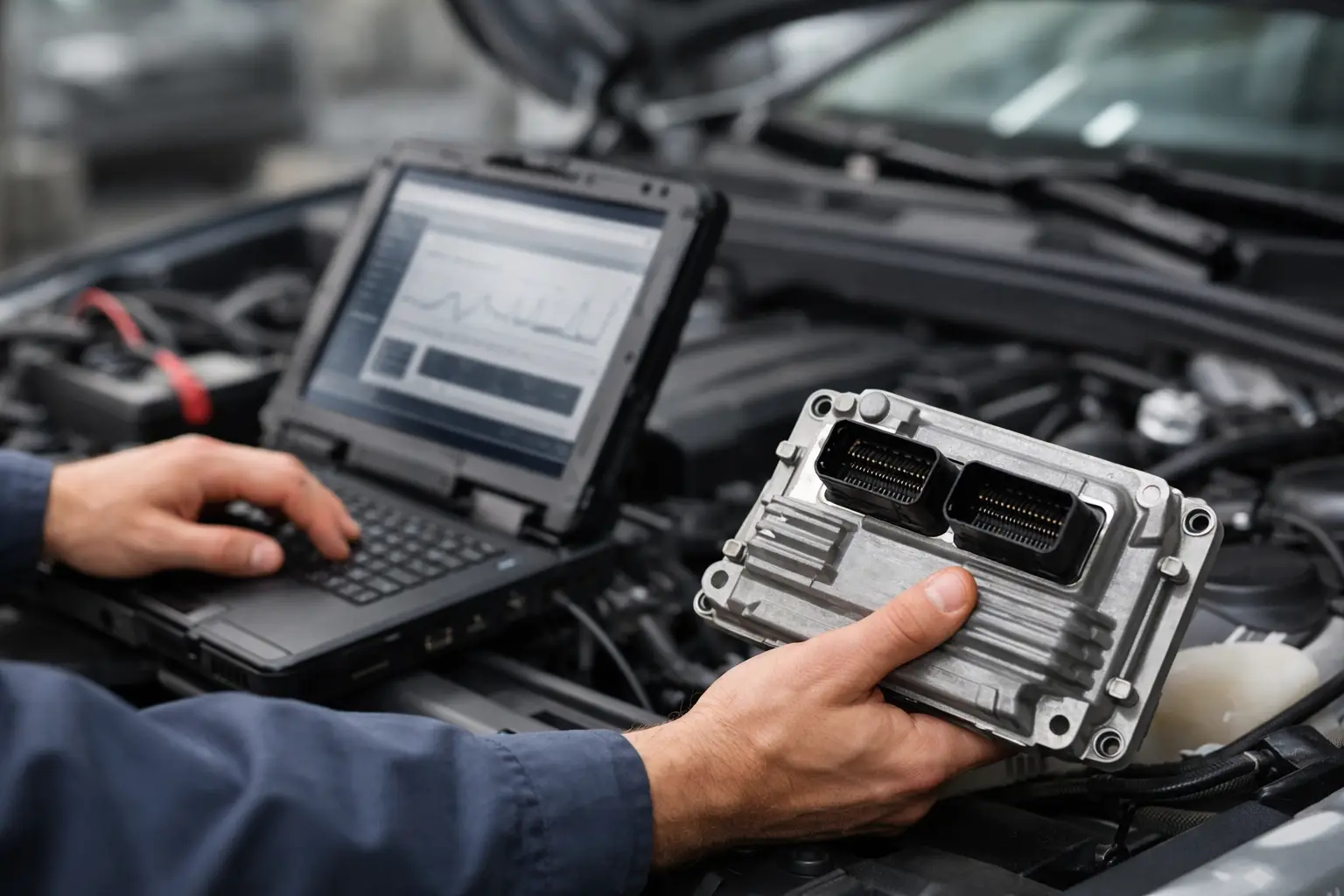
A machine can have no active fault codes, start cleanly, and still run poorly after a component replacement or failed repair attempt. That is where technicians ask, what does ECM reset do? In practical terms, an ECM reset clears selected learned values, stored states, or fault-related information so the controller can restart specific monitoring and adaptation processes. It does not automatically repair a mechanical failure, restore corrupt programming, or make an incompatible calibration correct.
The exact result depends on the OEM, controller family, diagnostic application, and reset command selected. On diesel engines, agricultural equipment, commercial vehicles, and construction machinery, “ECM reset” is a broad shop term. Before using it, identify whether the job calls for a key-cycle reset, fault-code clear, adaptive reset, service reset, module reboot, or full programming procedure.
What Does ECM Reset Do in a Service Workflow?
The engine control module continuously stores operating information. Depending on the platform, this can include learned idle control values, injector correction data, throttle or pedal adaptation, EGR position learning, turbo actuator position, aftertreatment counters, sensor plausibility history, and diagnostic trouble code status.
An ECM reset command may clear one or more of those values. Once the reset is complete, the module may require a key cycle, a specific idle period, a road test, a stationary regeneration, or an OEM-directed relearn routine before it can establish new baseline values.
A reset is commonly used after installing a replacement component, correcting a wiring or air-system issue, completing a calibration procedure, or resolving a condition that caused the ECM to enter a derate or protective strategy. It gives the controller an opportunity to evaluate the repaired system without relying on previous learned data or latched diagnostic states.
That distinction matters. Clearing a condition and correcting its root cause are not the same operation. If a pressure sensor is reading incorrectly because its reference circuit is damaged, resetting the ECM may temporarily remove the warning or restore normal command logic. The fault will return when the ECM sees the bad signal again.
The Main Types of ECM Reset
Technicians often use the same phrase for several different functions. Treating them as interchangeable can create unnecessary repeat work.
Fault-Code Clear
A diagnostic tool clears stored, pending, or inactive DTCs when the OEM conditions allow it. This may turn off a warning lamp and reset some readiness or monitoring status. It does not erase every permanent or historical record on every platform. Many modern systems retain event history, freeze-frame data, occurrence counts, or permanent emissions-related faults.
Use this function after recording the codes and related data. Clearing codes before documenting them can remove valuable clues about load, engine speed, temperature, or operating conditions present when the failure occurred.
Adaptive or Learned-Value Reset
An adaptive reset clears values the ECM developed over time to compensate for normal wear, environmental conditions, fuel variation, or component behavior. Examples can include idle trim, air-handling adaptation, throttle learning, transmission shift adaptation, and certain aftertreatment or actuator learned positions.
This is often the correct function after replacing parts that directly affect control feedback. An EGR valve replacement, electronic turbo actuator installation, fuel-system repair, or throttle body service may require a reset followed by a relearn. The service information for that exact machine determines whether the procedure is mandatory.
Module Reset or Reboot
A module reset restarts the controller without necessarily erasing calibrations, configuration, or all learned data. Think of it as a controlled power-cycle command performed through the diagnostic application. It can be useful when a module is communicating but has stopped responding correctly to a function after a programming session or network event.
A reboot is not a substitute for correct battery voltage, clean power and ground circuits, or CAN network diagnosis. If the controller is repeatedly dropping offline, resetting it only delays the real repair.
Service Reset and Counter Reset
Some OEM diagnostic platforms offer reset functions tied to maintenance items, aftertreatment service, oil quality monitoring, particulate filter replacement, DEF system repairs, or component installation. These procedures can reset calculated values or tell the module that a verified service event has occurred.
Use them only when the corresponding work is complete. Resetting a soot estimate, service counter, or replacement record without repairing the underlying system can lead to incorrect regeneration decisions, inaccurate maintenance tracking, or component damage.
What an ECM Reset Does Not Do
An ECM reset is not a universal cure for poor performance, no-start conditions, derates, or emissions faults. It will not fix a failed injector, a restricted fuel supply, a leaking charge-air cooler, damaged harness, low rail pressure, contaminated DEF, worn turbocharger, or incorrect engine timing.
It also does not normally replace programming. If a controller has the wrong calibration, incomplete flash, incompatible parameter set, or corrupted software, the correct repair may be an OEM-approved programming or recovery process. Resetting a module with unstable voltage during an active flash can create a no-communication condition or leave the controller unrecoverable without proper recovery tools.
Do not confuse an ECM reset with security access, immobilizer synchronization, parameter programming, injector coding, or password-protected factory functions. Some platforms require authorized access and specific software steps for those operations. A generic scan tool may clear codes but lack the ability to run the required relearn or installation routine.
When an ECM Reset Is Appropriate
A reset makes sense when the diagnostic path supports it. The best time is after the failure has been confirmed and repaired, not as the first action on an unknown complaint.
For example, if a machine had an intake pressure correlation code caused by a split charge-air hose, repair the hose, pressure-test the system, verify sensor readings, then clear the code and complete any required drive cycle. If an electronically actuated component was replaced, install it correctly, confirm its wiring and power supply, perform the specified setup or calibration, then reset the relevant learned values if the OEM procedure calls for it.
Before commanding any reset, capture the information that may disappear: active and inactive codes, event logs, freeze-frame data, calibration identification, hours, mileage, fuel level where relevant, battery voltage, and live data. This is especially important for intermittent issues and fleet equipment, where the same failure may appear only under load or at a certain ambient temperature.
Risks of Resetting the ECM Too Early
The most common problem is lost diagnostic direction. A code may return, but the freeze-frame conditions that pointed to the failure can be gone. Repeatedly clearing faults can also prevent a technician from confirming whether the repair changed the failure pattern.
Another risk is skipping the relearn period. After an adaptive reset, the equipment may idle differently, shift differently, or respond differently while the ECM rebuilds its learned values. That can be normal within the OEM-defined procedure, but it should not be mistaken for a completed repair until live data, functional tests, and operating performance are verified.
Voltage is another critical factor. Connect a stable power supply when working on commercial equipment or any platform requiring programming, setup, or long diagnostic routines. Weak batteries, poor grounds, and battery chargers with unstable output can interrupt communications and create avoidable controller faults.
Finally, do not use reset functions to bypass emissions-related diagnostics or conceal active faults. Federal and state emissions requirements still apply, and a reset does not make an unresolved emissions system defect acceptable for operation.
A Practical Reset Process for Professional Shops
Start with identification. Confirm the equipment serial number, engine family, ECM part number, software level, and installed calibration. Then use the correct brand-level diagnostic platform or a tool with verified coverage for the controller.
Read all modules, not only the engine ECM. A CAN fault, instrument cluster issue, body controller input, transmission fault, or low system voltage can affect engine behavior. Review live data against known-good conditions before replacing components or clearing memory.
After completing the physical repair, follow the OEM procedure in the correct order: clear faults if permitted, perform the named reset or relearn, complete the required key cycle or operating routine, and rescan the machine. Confirm that the command completed successfully, relevant parameters are plausible, and the original complaint is gone under the conditions that produced it.
For advanced workflows, the value is not in pressing a reset button. It is in using the correct reset function, on the correct controller, after a verified repair, with enough diagnostic coverage to confirm the result. That is how an ECM reset supports uptime instead of becoming another temporary fix.