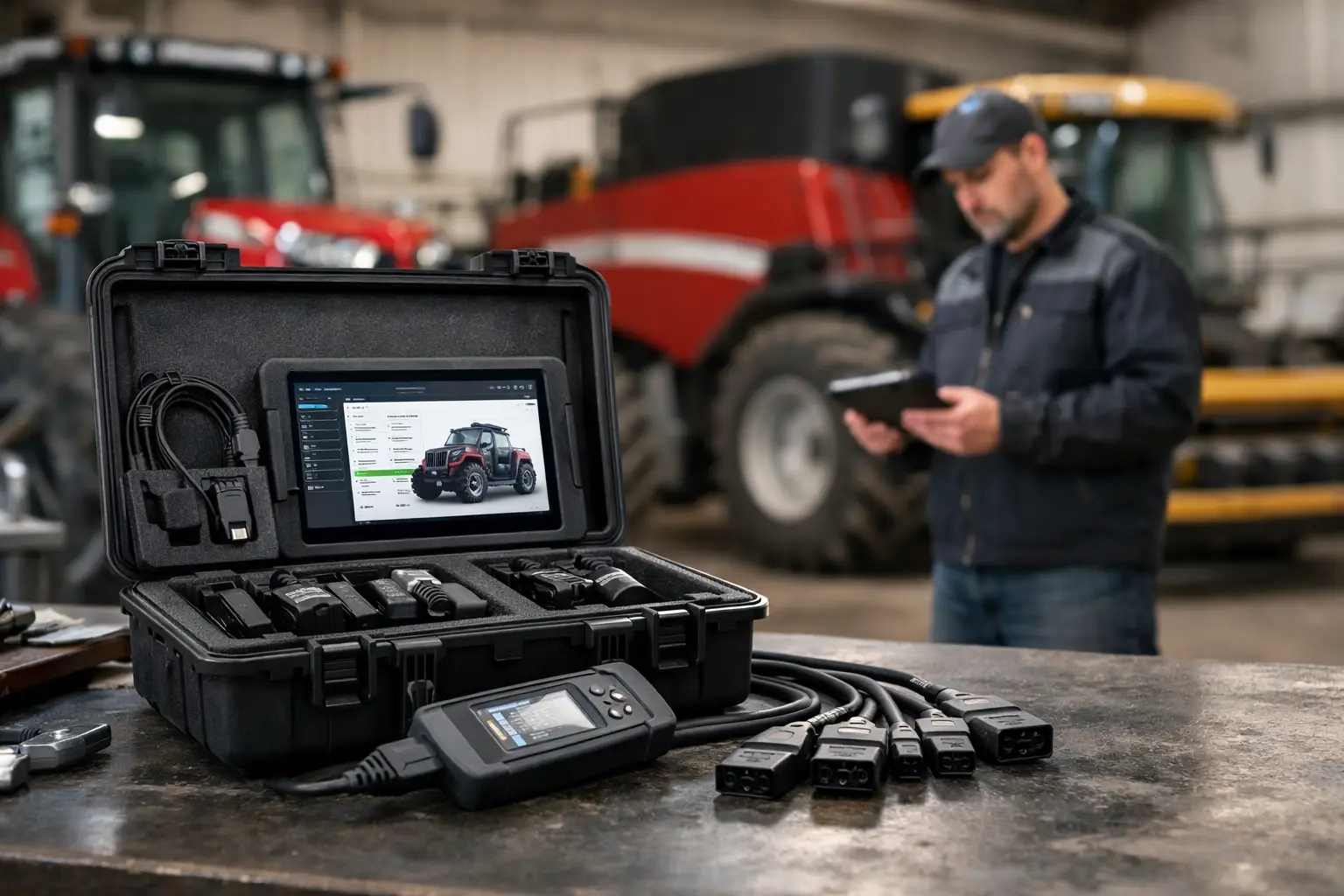
When an AGCO tractor or combine is down with an active fault, the real issue is rarely just reading the code. The value of an agco diagnostic kit is whether it gives your shop enough control to move from identification to repair, calibration, and return-to-service without waiting on dealer access.
For most professional users, that means the kit has to do more than basic scan functions. It needs to communicate reliably with AGCO electronic systems, support service workflows that match real shop conditions, and reduce the number of jobs that stall because a function is locked behind factory-level software. If the tool only gives you fault descriptions and limited live data, it may help with triage, but it will not carry a modern agricultural repair operation very far.
What an AGCO diagnostic kit is really for
An AGCO diagnostic kit is best understood as a service platform, not just an interface cable and a piece of software. In the field, technicians use it to identify control unit faults, monitor operating values, run tests, perform calibrations, reset learned parameters, and in some cases support programming or configuration tasks depending on machine family and software level.
That distinction matters. Many buyers assume any diagnostic package with AGCO branding or AGCO coverage will provide dealer-level functionality. In practice, capability varies widely. Some kits are limited to code reading and basic data streams. Others are built for full workshop use, where the technician needs to verify sensors, command outputs, complete setup procedures after component replacement, and restore machine operation without outside intervention.
For an independent repair shop, the gap between those two tool classes is expensive. A limited package can still leave you dependent on dealer visits for transmission calibration, controller replacement setup, hydraulic function learn procedures, or electronic service routines tied to machine uptime.
Core functions an AGCO diagnostic kit should include
At minimum, the kit should provide stable communication with the machine, dependable fault code access, and live parameter monitoring. That is the baseline. Without those functions working properly across the supported AGCO platforms, the rest of the toolset does not matter.
The next level is where the real shop value starts. A capable AGCO diagnostic kit should support bi-directional tests and service procedures. That includes commanding actuators, checking switch and sensor response, verifying control logic, and running guided calibrations after repair work. If you replace an electronic component but cannot complete the required calibration, the repair is only half finished.
Programming and configuration support can be the deciding factor, but this is where buyers need to pay attention to exact coverage. Not every kit that claims programming support handles every controller, and not every machine family allows the same workflow. Some applications may support parameter changes and setup functions, while full ECU programming or software loading may require additional files, licenses, or factory-authorized access. That does not make the kit weak – it just means you need to match the tool to the jobs your shop actually performs.
Coverage matters more than marketing claims
AGCO is not a single-machine environment. A workshop may see Massey Ferguson, Fendt, Challenger, or other AGCO-related platforms with major differences in electronics architecture, controller layout, and diagnostic communication. A tool that performs well on one range may offer reduced function on another.
That is why coverage should be checked at machine-series level whenever possible. Broad claims such as AGCO support or agricultural coverage are not enough for a professional buyer. You need to know which brands, model families, and systems are included. Engine diagnostics, transmission systems, hydraulic control, emissions aftertreatment, cab electronics, and implement communication may not all be covered equally.
The same caution applies to software versioning. A package built around older machine generations may still be useful for mixed fleets, but it may not be the right choice if your workload leans heavily toward newer electronically managed equipment. On the other hand, if your business services a large installed base of proven older tractors and combines, paying extra for coverage you will rarely use is not always the smart move.
Hardware and software are only part of the equation
A shop-ready AGCO diagnostic kit needs dependable hardware, but reliability is not just about the interface box. It also depends on driver stability, operating system compatibility, and how cleanly the application installs and launches in a working service laptop environment.
This is where many low-grade packages fail. They may include software that technically opens, but connection quality is inconsistent, functions are incomplete, or communication drops during active service procedures. That kind of instability is more than an inconvenience. If you are in the middle of a calibration or controller-related operation, unreliable communication creates unnecessary risk.
Professional users should also consider how the kit fits into daily workshop use. Can one technician move from machine identification to fault isolation quickly? Is the interface responsive enough for live data analysis? Are the menus structured in a way that supports service workflow instead of slowing it down? Time lost navigating poor software adds up across a season.
Choosing the right AGCO diagnostic kit for your shop
The right choice depends on the jobs you want to keep in-house. If your goal is basic troubleshooting, a simpler package may be enough. If your workload includes electronic component replacement, post-repair setup, controller resets, and advanced calibration procedures, you need a higher-function diagnostic solution.
It also depends on your customer base. A mobile ag service provider working across several machine brands may prioritize broad compatibility and fast deployment. A dedicated AGCO-focused shop may care more about deeper function on specific platforms, even if that means a more specialized setup. Fleet maintenance departments often sit somewhere in the middle – they want predictable support for the exact units they own, not generic coverage claims.
Before buying, define the tasks that currently force you to send work elsewhere. If your shop regularly loses margin because it cannot complete controller matching, service interval resets, calibration routines, or electronic troubleshooting beyond basic code reading, that is where the kit must deliver. Buying on price alone usually leads to a tool that handles the easy 20 percent of the job and leaves the hard 80 percent unresolved.
Trade-offs professionals should keep in mind
There is no single AGCO diagnostic kit that is perfect for every operation. A broader aftermarket package may cover more brands in your shop, but sometimes with less depth than a tighter AGCO-specific tool. A more advanced package may expand programming and calibration capability, but it can also require a more disciplined laptop setup and a technician who is comfortable with software-driven service procedures.
There is also the question of update strategy. Some shops want a stable package they can keep dedicated to a known machine range. Others need current coverage because they service newer units with newer controllers. Stability and recency do not always align perfectly, so your best option depends on whether your business is centered on a fixed installed base or an evolving customer fleet.
Support files and technical utilities can matter just as much as the main software. Password tools, configuration files, firmware resources, and machine-specific service data can turn a good diagnostic package into a complete workshop solution. For many professional buyers, that is the real threshold between a scanner and a system.
Why shops are moving toward deeper diagnostic capability
Dealer dependency is expensive, especially during planting, harvest, or peak hauling windows. When equipment is waiting on a locked function, delayed calibration, or electronic service procedure, the direct repair cost is only part of the problem. The bigger cost is downtime, lost scheduling control, and the inability to finish jobs on your own timeline.
That is why more independent shops and advanced owner-operators are investing in higher-function AGCO service tooling. The goal is not just access to fault codes. The goal is to bring more dealer-grade workflow in-house, where the repair can be diagnosed, completed, and verified without handing the final step to someone else.
For buyers comparing options, the best approach is simple. Judge the AGCO diagnostic kit by what it lets you finish, not by what it lets you open. If it supports the real service procedures your shop needs, improves turnaround, and reduces outside dependency, it is doing its job. If not, it is just another screen in the toolbox.
A good diagnostic platform should give you more than information – it should give you control where downtime actually gets expensive.